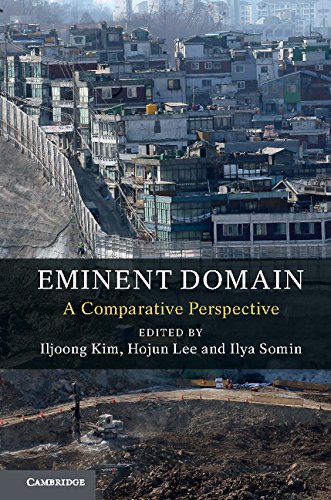
Eminent domain : a comparative perspective / edited by Iljoong Kim, Sungkyunkwan University, Seoul; Hojun Lee, Korea Development Institute, Sejong; Ilya Somin, George Mason University, Virginia.
Material type: TextPublisher: Cambridge, United Kingdom ; New York, NY : Cambridge University Press, 2017Description: xii, 316 pages : illustrations ; 23 cmContent type:
 - text
- unmediated
- volume
- 9781316628331
- 9781107177291
- 343.025 23 EMI
- K3511 .E47 2017
| Cover image | Item type | Current library | Home library | Collection | Shelving location | Call number | Materials specified | Vol info | URL | Copy number | Status | Notes | Date due | Barcode | Item holds | Item hold queue priority | Course reserves | |
|---|---|---|---|---|---|---|---|---|---|---|---|---|---|---|---|---|---|---|
 Books
Books
|
KING CEASOR UNIVERSITY LIBRARY Reserve Section | Non-fiction | 343.025 EMI (Browse shelf(Opens below)) | 1 | Available | 6576 |
Includes bibliographical references and index.
Machine generated contents note: 1. Taking law from an economic perspective with reference to German law Hans-Bernd Schafer; 2. Eminent domain in the United States Ilya Somain; 3. Direct expropriation: the multi-layered legal protection in Europe Anne van Aaken; 4. Eminent domain law in Taiwan: new law, old practice? Yun-chien Chang; 5. Compulsory land acquisition in developing countries: shifting paradigm or entrenched legacy? Jonathan Lindsay, Klaus Deininger and Thea Hilhorst; 6. Public interest criteria and Korea's scrutiny system Hojun Lee; 7. Who exercises the eminent domain power in Korea? A focus on private takings Iljoong Kim; 8. Just compensation in eminent domain in Korea: from the perspective of fairness Byungkoo Cho; 9. Overall due process in takings in Korea Kisang Jung; 10. Distribution of development surplus in takings Sungkyu Park; 11. Takings, disputes, and resolutions in Korea: a quantitative review Duol Kim.
"The taking of private property for development projects has caused controversy in many nations, where it has often been used to benefit powerful interests at the expense of the general public. This edited collection is the first to use a common framework to analyze the law and economics of eminent domain around the world. The authors show that seemingly disparate nations face a common set of problems in seeking to regulate the condemnation of private property by the state. They include the tendency to forcibly displace the poor and politically weak for the benefit of those with greater influence, disputes over compensation, and resort to condemnation in cases where it destroys more economic value than it creates. With contributions from leading scholars in the fields of property law and economics, the book offers a comparative perspective and considers a wide range of possible solutions to these problems"-- Provided by publisher.
"The taking of private property for development projects has caused controversy in many nations, where it has often been used to benefit powerful interests at the expense of the general public. This edited collection is the first to use a common framework to analyze the law and economics of eminent domain around the world. The authors show that seemingly disparate nations face a common set of problems in seeking to regulate the condemnation of private property by the state. They include the tendency to forcibly displace the poor and politically weak for the benefit of those with greater influence, disputes over compensation, and resort to condemnation in cases where it destroys more economic value than it creates. With contributions from leading scholars in the fields of property law and economics, they offer a comparative perspective and consider a wide range of possible solutions to these problems"-- Provided by publisher.
There are no comments on this title.