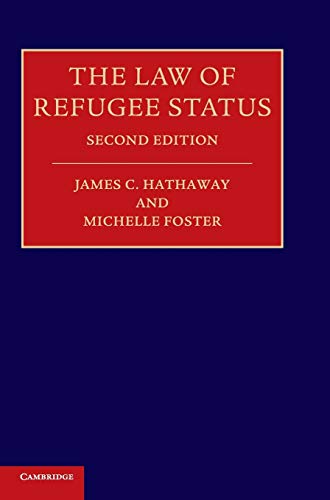
The law of refugee status / James C. Hathaway and Michelle Foster.
Material type: TextPublisher: Cambridge, United Kingdom : Cambridge University Press, 2014Edition: Second editionDescription: lxxxi, 693 pages ; 26 cmContent type:
 - text
- unmediated
- volume
- 9781107012516
- 9781107688421
- 341.4 23 HAT
- KZ6530 .H38 2014
- POL035010
| Cover image | Item type | Current library | Home library | Collection | Shelving location | Call number | Materials specified | Vol info | URL | Copy number | Status | Notes | Date due | Barcode | Item holds | Item hold queue priority | Course reserves | |
|---|---|---|---|---|---|---|---|---|---|---|---|---|---|---|---|---|---|---|
 Books
Books
|
KING CEASOR UNIVERSITY LIBRARY Reserve Section | Non-fiction | 341.4 HAT (Browse shelf(Opens below)) | 1 | Available | 6510 |
Browsing KING CEASOR UNIVERSITY LIBRARY shelves,Shelving location: Reserve Section,Collection: Non-fiction Close shelf browser (Hides shelf browser)


Includes bibliographical references and index.
Machine generated contents note: 1. Alienage; 2. Well-founded fear; 3. Serious harm; 4. Failure of state protection; 5. Nexus to civil or political status; 6. Persons no longer needing protection; 7. Persons not deserving protection.
"The first edition of The Law of Refugee Status (published in 1991) is generally regarded as the seminal text on interpreting the refugee definition set by the UN's 1951 Refugee Convention. Its groundbreaking analysis served as the bedrock for not only much judicial reasoning, but also for a burgeoning academic literature in law and related fields. This second edition builds on the strong critical focus and human rights orientation of the first edition, but undertakes an entirely original analysis of the jurisprudence of leading common law and select civil law states. The authors provide robust responses to the most difficult questions of refugee status in a clear and direct way. The result is a comprehensive and truly global analysis of the central question in asylum law: who is a refugee?"-- Provided by publisher.
"Refugee law may be the world's most powerful international human rights mechanism. Not only do millions of people invoke its protections every year in countries spanning the globe, but they do so on the basis of a self-actuating mechanism of international law that, quite literally, allows at-risk persons to vote with their feet. This is because, as the United Nations High Commissioner for Refugees ("UNHCR") has insisted, refugee status is not a status that is granted by states; it is rather simply recognized by them"-- Provided by publisher.
There are no comments on this title.