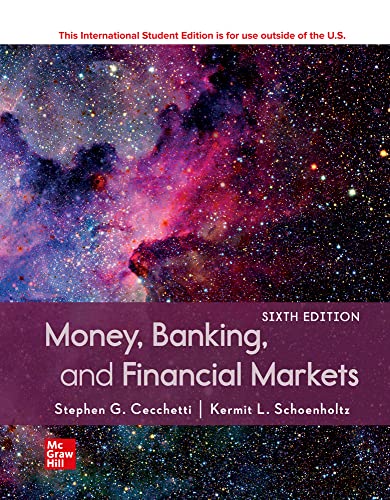
Money, banking, and financial markets / Stephen G. Cecchetti, Brandeis International Business School, Kermit L. Schoenholtz, New York University Leonard N. Stern School of Business.
Material type: TextPublisher: New York . McGraw-Hill Education, (2021)Edition: Sixth EditionDescription: xxxiv, 672 p. ; col., ill. : 20 x 3 x 26 cm Carrier type:
 - volume
- 978-1260571363
- 9781260226782
- 9781264058693
- 332 23 ed. CEC
- HG221 .C386 2021
| Cover image | Item type | Current library | Home library | Collection | Shelving location | Call number | Materials specified | Vol info | URL | Copy number | Status | Notes | Date due | Barcode | Item holds | Item hold queue priority | Course reserves | |
|---|---|---|---|---|---|---|---|---|---|---|---|---|---|---|---|---|---|---|
 Books
Books
|
KING CEASOR UNIVERSITY LIBRARY Reserve Section | Non-fiction | 332 CEC (Browse shelf(Opens below)) | 2 | Available | 4080 | ||||||||||||
|
Books
|
KING CEASOR UNIVERSITY LIBRARY Reserve Section | Non-fiction | 332 CEC (Browse shelf(Opens below)) | 1 | Available | 4045 |
Previous edition published in 2017.
Includes glossaries and index
"The entire content of this book is based on five core principles. Knowledge of these principles is the basis for understanding what the financial system does, how it is organized, how it is linked to the real economy, and how it is changing. If you understand these five principles, you will understand the future: 1. Time has value. 2. Risk requires compensation. 3. Information is the basis for decisions. 4. Markets determine prices and allocate resources. 5. Stability improves welfare"-- Provided by publisher.
Ages 18+ years McGraw-Hill
Grades 10-12 McGraw-Hill
There are no comments on this title.